
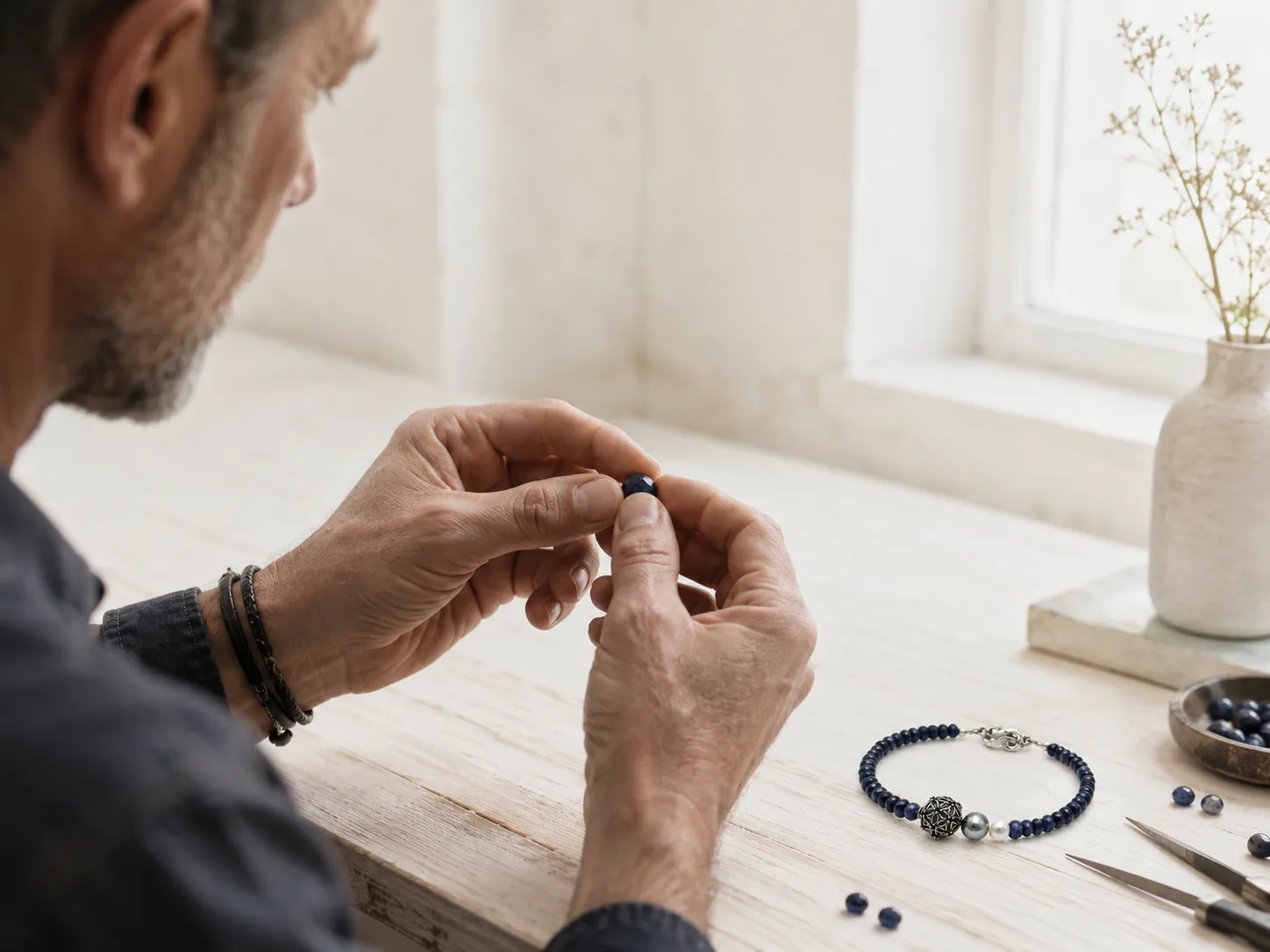
The craftsman has worked in the atelier for years. He does not put himself forward, does not sign the pieces, does not tell his trade in shop windows. Yet every bracelet passes through his hands before leaving the workshop — and it is his eye, in the end, that decides whether a piece goes out or stays.
His first relationship is with matter. He takes a stone between his fingers before looking at it, weighs it, follows the grain, sets it down. A stone that feels too light goes back to the drawer. A denser one, more closed, is set aside for a later assembly. This way of judging is not taught in books — it is built across hundreds of pieces handled.
His method is slower than one might think. He does not braid in series. Each bracelet is started, set down, picked up an hour later, adjusted in daylight. Tension that is too tight is felt by the third stone; a knot misplaced shows by the sixth. He would rather undo than let it pass.
His view of jewellery fits in few words. A bracelet is not an ornament: it is a piece worn over time, one that ends up belonging to the wrist, that asks for no attention. The matter must hold, the assembly must disappear, the intention must stay quiet. The rest — the light, the gesture of the one wearing it — no longer belongs to him.
One detail says it all. When a bracelet leaves the atelier, he does not look at it. He sets it down on the bench, walks away, returns to another piece. For him, a bracelet is finished the moment it stops interesting him — that is, when there is nothing left to correct.
by Atelier Laracca